

Why stable rental income does not always guarantee a straightforward refinance, and how investors can prepare.
Your tenant pays on time, the property is occupied, and rental income covers the mortgage payments. Then your commercial mortgage approaches maturity, and the replacement loan is smaller than the amount you need to repay.
For investors considering commercial property refinancing in the UK, this is an important possibility to prepare for. A property can continue to perform well while the financing available against it changes, particularly when the original loan was arranged under different market conditions.
Recent developments have made this distinction more relevant. On 5 November 2026, the Bank of England announced a 0.25 percentage point increase in Bank Rate to 4%, while emphasising that future decisions would depend on economic evidence. Separately, the RICS Q3 2026 UK Commercial Property Monitor reported tighter credit conditions, even as respondents continued to anticipate rental growth for prime offices and industrial property. Together, these developments highlight how rental performance and access to finance can move differently. Bank of England monetary policy minutes; RICS commercial property findings
For property owners, the question is how much replacement funding the asset can support when the existing facility ends. Whether you want to refinance a commercial mortgage, release equity for another purchase or restructure a property portfolio, answering that question early provides a firmer basis for your next decision.
Why a performing property can still face a refinancing shortfall
A commercial mortgage refinance is shaped by both the property’s value and the income available to support borrowing. The loan-to-value ratio, or LTV, limits the loan relative to the valuation accepted by the lender. The income assessment considers whether recognised rental income can support the proposed interest payments or total debt service. Both constraints must be satisfied, alongside the lender’s wider assessment of the borrower, tenant, lease and property.
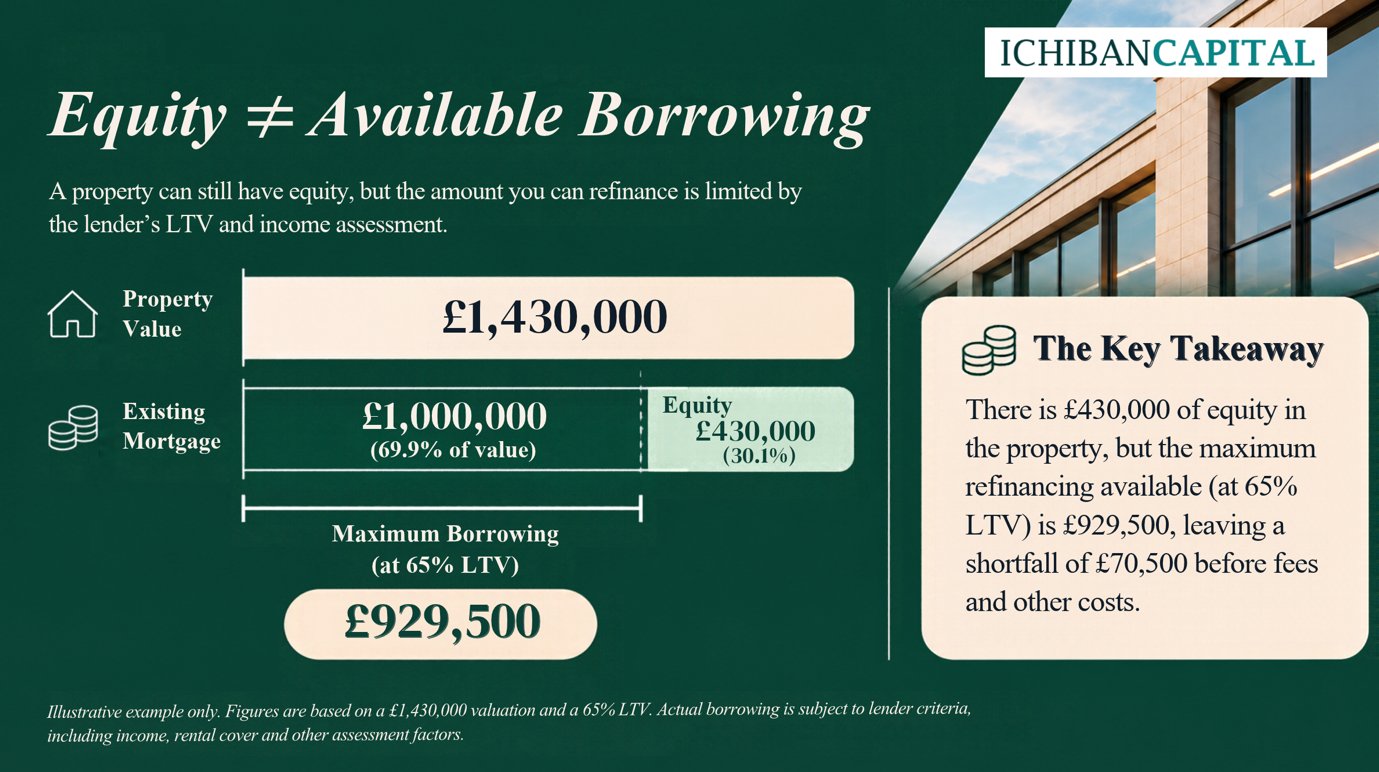
Consider a commercial investment generating £100,000 in annual net property income. Using a simplified income capitalisation calculation, a valuation yield of 6% implies a property value of approximately £1.67 million. At an assumed maximum LTV of 65%, that would support borrowing of approximately £1.08 million on valuation grounds alone. If the valuation yield moves to 7%, with income unchanged, the implied value falls to approximately £1.43 million, and the corresponding loan ceiling falls to approximately £929,000. Against an existing mortgage balance of £1 million, this leaves a refinancing shortfall of approximately
£71,000 before fees and other costs.
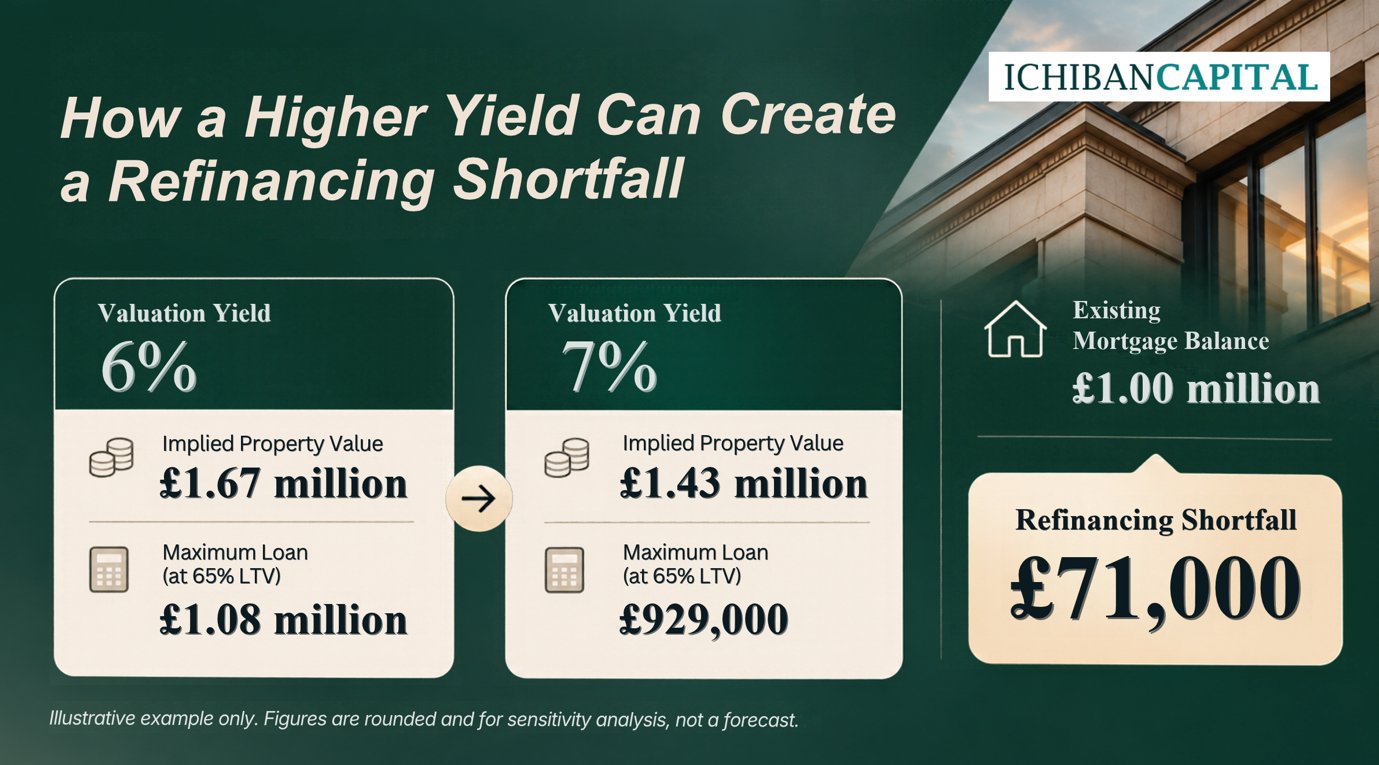
These figures are a sensitivity test, not a prediction of the effect of November’s rate decision. A 0.25 percentage point change in Bank Rate does not automatically produce a one percentage point movement in property yields. Actual valuations reflect market evidence and the characteristics of the asset. Nevertheless, the example illustrates an important point: the tenant can continue paying the same rent while the amount available to refinance the property falls.
Income can impose a separate restriction. Rent that comfortably covers an existing interest-only mortgage may support less borrowing if the replacement facility carries a higher interest rate or requires capital repayments. Lenders may also differ in their treatment of operating costs, lease events and sustainable rental income. This is where a commercial property finance broker can help assess which funding routes fit the transaction, what evidence is required and whether the requested borrowing is realistic. At Ichiban Capital, our property finance service supports commercial acquisitions, refinancing and more complex funding requirements.
Releasing equity requires a realistic view of available cash
A refinancing gap does not necessarily mean the property is worth less than its debt. In the example above, the lower valuation still leaves equity above the £1 million mortgage. The difficulty is that this equity cannot automatically be converted into enough borrowing to repay the existing lender. For investors planning to release equity from commercial property, that distinction can affect the funding available for another acquisition or refurbishment.
The relevant figure is the net cash available after refinancing: the approved replacement loan, less the amount required to redeem the existing facility and applicable fees or deductions. A £1.1 million new loan against a £1 million redemption balance leaves £100,000 before refinancing costs. Committing that full amount to another purchase before confirming the net proceeds could leave the investor needing additional cash at completion.
A useful funding review therefore connects the commercial remortgage to the transaction it is intended to support. It considers a realistic range of valuations and loan amounts, the timing of both transactions and the cash available if the outcome is less favourable than expected. For clients with several assets, property portfolio refinancing also requires a broader view. A mortgage maturity on one building may coincide with a tenant departure or major expenditure on another, creating a combined cash requirement that is easy to miss when each property is reviewed separately.
Choosing finance that fits the property’s next stage
Commercial mortgage rates matter, but the overall suitability of a facility depends on its full structure. Arrangement fees, capital repayments, early repayment charges and the outstanding balance at maturity can all affect the investment. An owner planning to sell or refurbish within a few years may need different terms from an investor intending to hold the property for the long term. Where several assets secure one facility, the conditions for releasing an individual property also deserve attention.
Lease timing is equally important. A property that is fully occupied today may have a tenant break option shortly before the mortgage matures. A planned refurbishment may increase rental potential, but the works, letting process and evidence required by the next lender all take time. Reviewing the loan and lease together helps you see what the asset may look like when you need replacement finance, rather than assuming today’s position will remain unchanged.
Commercial bridging finance may help when additional time supports a defined improvement, such as completing refurbishment or finalising a tenancy before applying for longer-term funding. However, the exit must remain achievable after interest and costs. If the underlying problem is insufficient long-term borrowing capacity, a short-term loan may postpone the gap while increasing the amount owed. Ichiban Capital helps clients explore bridging finance options with the proposed repayment strategy central to assessing whether the facility suits the transaction.
Preparing your commercial property refinance with Ichiban Capital
Starting a review before the existing mortgage expires creates time to gather evidence, compare suitable lenders and respond if the expected funding is unavailable. The starting information includes the current balance and maturity date, redemption terms, lease documents, rental income and planned expenditure. Together, these helps establish how much must be repaid, what the property may support and whether additional capital could be released.
The value of this process is a clearer basis for decisions. It may reveal that the proposed refinance is achievable, that the borrowing requirement needs adjusting, or that another acquisition should be timed differently. Comparing suitable funding options also means understanding how each lender’s approach fits the case, rather than whether the lowest advertised rate will produce the most appropriate outcome.
At Ichiban Capital, we help investors explore commercial mortgages, property refinancing and portfolio restructuring, including transactions that require a more tailored lending approach. We work from the asset, the existing borrowing and the investor’s objectives to identify suitable funding routes and support the application process.
If your commercial mortgage is approaching maturity, or you are considering releasing capital for another investment, contact Ichiban Capital to discuss your property refinancing requirements and next steps.
FAQs
Can I refinance a commercial property with an existing mortgage?
Yes, subject to lender approval. The new loan repays the existing mortgage, but any funding shortfall must be covered separately.
Can refinancing release equity from my property?
Potentially. The amount available depends on the approved loan, existing debt and refinancing costs.
Does stable rental income guarantee approval?
No. Lenders also assess the valuation, lease terms, tenant strength and borrower circumstances.
How can Ichiban Capital help?
We help you explore suitable commercial mortgage and refinancing options based on your property and funding needs.