

For international investors looking to buy property in the UK, arranging finance can be very different from borrowing in their home market.
UK lenders may consider applications from foreign nationals living overseas, including investors whose income, assets and financial history are primarily outside the UK. The options available can depend on where the investor lives, how their income is generated, the currency they are paid in, their credit profile, available capital and the type of UK property they intend to purchase.
Two international investors buying similar properties at the same price may therefore receive very different lending options. Understanding how UK lenders assess overseas applicants can help investors prepare their finances and documentation before committing to a purchase.
Can Foreign Investors Get Property Finance in the UK?
Foreign nationals living outside the UK may be able to obtain finance to purchase UK property, including Buy-to-Let and other investment properties, subject to lender criteria.
Eligibility varies across the market. Some lenders accept applicants resident in a broad range of countries, while others restrict the jurisdictions they will consider. Foreign income, ownership structure, property type, deposit and the intended use of the property can also affect the options available.
An international investor is assessed across several connected factors, including nationality, country of residence, income, available capital and the proposed UK property transaction.
How Lenders Assess an International Investor
A lender needs to understand both the investor and the property transaction. International applications can require additional information where income, assets and financial history are held outside the UK.
Country of residence and nationality. Both can affect lender eligibility, and individual lenders may have their own criteria for the countries and jurisdictions they will consider.
For example, two foreign investors with similar incomes and deposits may have different lending options if they are resident in different countries. This can reflect the lender’s internal risk policies, compliance requirements and its ability to verify financial information in a particular jurisdiction.
For an overseas investor, lender eligibility therefore depends on the combination of nationality, country of residence, financial position and the proposed UK property transaction.
Foreign income and currency. Many international investors earn their income outside the UK. How that income is assessed varies between lenders.
Suppose an overseas investor earns the equivalent of £120,000 a year. A lender may consider how long the applicant has received the income, its stability, the currency in which it is paid and the documentation available to support it. Exchange-rate movements may also be relevant where income is earned in one currency and mortgage commitments are denominated in pounds.
Employment structure can affect the assessment as well. An employed investor may evidence earnings through an employment contract, payslips and bank statements. A self-employed investor or company owner may need to provide company accounts, tax documentation, dividend information or evidence relating to their ownership of the business, depending on the lender.
Clear and verifiable income information gives the lender a stronger basis for assessing the investor’s financial position.
Credit history. A foreign investor may have little or no established UK credit history, particularly if they have never previously lived, worked or borrowed in the UK.
A limited UK credit footprint is different from adverse credit. Depending on the lender and type of finance, overseas credit information, bank statements, existing borrowing and the investor’s wider financial history may form part of the assessment.
Criteria vary across the market, making lender selection particularly important for international investors whose financial history is primarily held outside the UK.
Deposit, Source of Funds and Compliance
For an international investor purchasing UK property, the amount of capital contributed to the transaction can influence the finance available.
There is no single deposit requirement that applies to every overseas investor. The amount required can vary according to the lender, country of residence, property, type of finance and the investor’s wider financial profile.
The origin of that capital also needs to be clear.
An investor may have accumulated their deposit through employment income, business profits, investments, inheritance or the sale of another asset or property. Funds may also have moved between different accounts, companies or jurisdictions before being used for a UK purchase.
UK anti-money-laundering guidance distinguishes between the bank account from which money is transferred and the HYPERLINK “https://www.gov.uk/hmrc-internal-manuals/anti-money-laundering-guidance-for-supervised-businesses/amlg11630?utm_source=chatgpt.com”source of funds itself. Source of funds checks can involve establishing how the money being used for a particular transaction was originally generated.
International property transactions can involve additional verification where the investor’s income, capital, businesses or beneficial ownership interests are spread across several countries. A clear documentary trail can help demonstrate how the investment capital was accumulated and how it reached the account being used for the UK purchase.
For overseas investors planning a transaction, organising this information early can help reduce avoidable questions later in the process.
Ownership Structure and Preparing Your Application
International investors also need to consider how the UK property will be held.
Some purchase investment property in their personal name, while others use a UK limited company or Special Purpose Vehicle (SPV). The chosen structure can affect how the financing application is assessed.
Where a company is borrowing, a lender may consider the company alongside its directors, shareholders and wider ownership structure. Personal guarantees may also be required depending on the lender and facility. Where directors or shareholders are based overseas, additional verification may form part of the process.
The appropriate ownership structure depends on the investor and transaction, with financing, tax and legal considerations all playing a role. Relevant professional advice should be taken before deciding how a UK property will be held.
Making this decision early can also prevent complications once a purchase is already in progress.
Documents an Overseas Investor May Need
Requirements vary between lenders, but an international investor may be asked to provide:
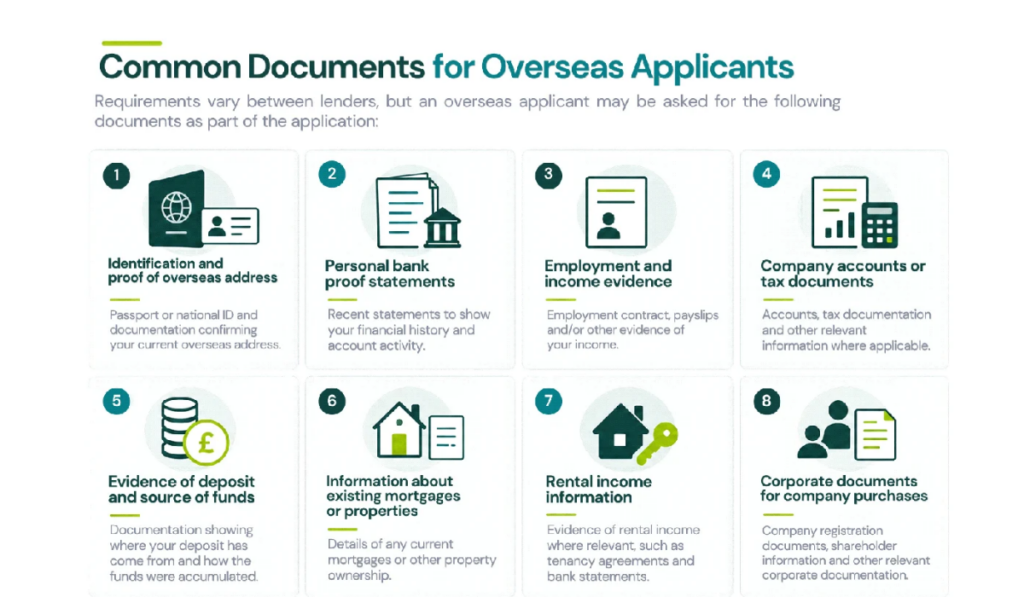
The documents should give the lender a financial picture that is easy to follow.
For example, if an international investor is contributing £150,000 towards a UK property purchase, the supporting information should show how those funds were accumulated and how they reached the account being used for the transaction.
Reviewing the documentation early can also identify missing information before the application reaches underwriting, particularly where an investor has income, assets or business interests across several jurisdictions.
From Identifying a UK Property to Completing the Purchase
International investors can benefit from considering finance before committing to a particular UK property. An early assessment can provide an indication of likely borrowing parameters and highlight lender criteria that could affect the proposed investment.
A practical sequence is:
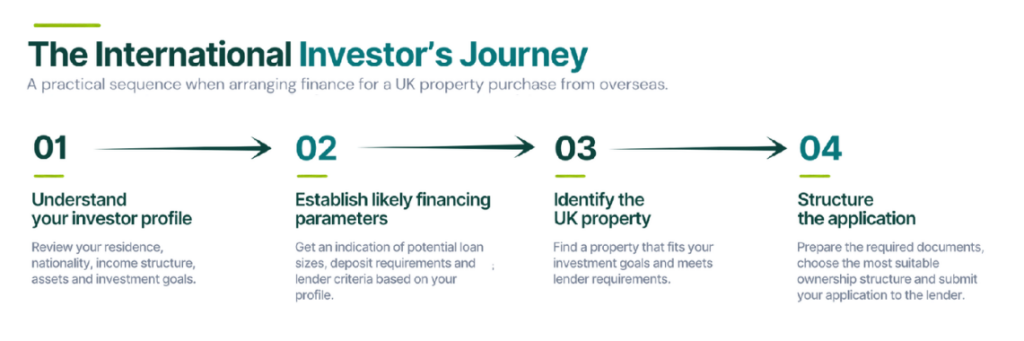
The property itself will still need to meet the lender’s requirements. Its value, condition, type, location and intended use can all influence the final lending decision.
Once a property has been identified, the investor and transaction can be assessed together. This includes the applicant’s country of residence and income, the capital available for the purchase, the property, its intended use and the proposed ownership structure.
Suitable financing routes can then be explored and the application prepared. The lender will usually require a valuation and carry out underwriting on the investor, property and wider transaction.
International applications can generate further questions where income, capital or ownership crosses jurisdictions. Documentation prepared earlier in the process can help address these enquiries efficiently.
If the lender is satisfied with the application and property, a formal offer may be issued and the purchase can progress through the remaining legal work towards completion.
The transaction timescale also affects the financing strategy. A standard purchase with sufficient time available may be suitable for a conventional mortgage process. An auction purchase or another transaction with a short completion deadline may require a different form of finance.
Understanding the timescale early helps ensure that the chosen financing structure fits the transaction.
Costs and Tax for Overseas UK Property Investors
Financing is only one part of the overall cost of investing in UK property from overseas.
International investors should also account for legal work, valuation and survey costs, financing fees and insurance. Depending on the investment strategy, there may also be costs associated with property management, maintenance or refurbishment.
Stamp Duty Land Tax is another important consideration for investors purchasing residential property in England and Northern Ireland.
Buyers treated as non-UK resident for the transaction are generally subject to an additional 2 percentage point SDLT surcharge on top of the residential rates that would otherwise apply.
The HYPERLINK “https://www.gov.uk/guidance/rates-of-stamp-duty-land-tax-for-non-uk-residents?utm_source=chatgpt.com”SDLT residence test for non-UK residents has its own rules. Nationality, citizenship or visa status alone does not determine whether the surcharge applies.
Other SDLT rules can affect the amount payable, including higher rates that may apply to additional residential properties. Tax treatment depends on individual circumstances, and international investors should obtain appropriate tax and legal advice when considering the ownership and overall cost of a UK property investment.
Preparing for UK Property Finance as an International Investor
International property finance depends on how the investor, capital and transaction fit together.
Country of residence can affect lender eligibility. Foreign income may be treated differently according to its currency and source. A limited UK credit history can influence which lenders are appropriate. The deposit and its source need to be evidenced, while the ownership structure and property itself can introduce further considerations.
Before approaching the UK finance market, an international investor should have a clear picture of five areas:
- Where are you resident and what is your nationality?
- How is your income generated and in what currency?
- How much capital are you investing and where did it come from?
- What UK property are you buying and what is your investment strategy?
- Will the property be held personally or through a company, and what finance will the transaction require?
Having these points clear provides a stronger basis for identifying lenders and financing options suited to the proposed UK property investment.
How Ichiban Capital Can Help International Investors
Ichiban Capital works with international clients seeking finance for UK property purchases and investments.
For an overseas investor, we consider the applicant’s circumstances alongside the UK property, foreign income, available capital, ownership structure, investment strategy and transaction timescale. This provides a clearer basis for exploring financing options that fit the proposed purchase.
Depending on the transaction, this may include Buy-to-Let Finance, Bridging Finance, Development Finance or other Specialist Property Finance, subject to lender criteria.
If you are an international investor considering the purchase or refinancing of UK property, contact Ichiban Capital to discuss your financing requirements.
Finance is subject to status, lender criteria, valuation and underwriting. Rates, fees and terms may vary. Your property may be repossessed if you do not keep up repayments on a mortgage or secured loan. Some forms of Buy-to-Let, overseas and commercial finance are not regulated by the FCA.
FAQ
Can foreign investors get property finance in the UK?
Yes. Overseas investors may be able to access UK property finance, subject to lender criteria. Ichiban Capital can help review your circumstances and explore suitable financing options for the proposed UK property purchase.
Can UK lenders accept income earned overseas?
Yes, depending on the lender. Income currency, stability, source and supporting documentation can all affect how foreign income is assessed.
Do I need a UK credit history?
Not always. Some lenders may consider overseas financial information where an international investor has limited UK credit history. Ichiban Capital can help identify financing routes based on the investor’s wider financial profile and transaction.
Can I buy UK investment property through a company or SPV?
Potentially. Overseas investors may purchase through a UK limited company or SPV, although lender requirements vary. Tax and legal advice should also be considered when deciding how the property will be held.