
Can You Get Property Finance with Bad Credit in the UK?
Having a poor credit history can make securing property finance more challenging, but it doesn’t necessarily mean putting your investment plans on hold. Whether you’re purchasing a buy-to-let property, financing a refurbishment or refinancing an existing investment, specialist lenders may still be willing to consider your application. Unlike conventional lending, where credit history can be a significant factor in determining eligibility, some specialist lenders may take a broader view of the transaction, considering the property’s value, available equity and repayment strategy alongside the borrower’s financial circumstances.
For property investors, the question is therefore not simply whether bad credit prevents borrowing, but how different lenders assess risk and what makes a particular transaction suitable for financing.

How Does Bad Credit Affect Property Finance?
A low credit score doesn’t automatically lead to rejection. UK lenders use their own underwriting criteria, and the circumstances behind a credit issue can matter just as much as the score itself. For instance, an investor with a CCJ from four years ago that has since been satisfied may be assessed differently from someone who has missed several repayments in recent months. Even if both investors are purchasing a £300,000 rental property with a £90,000 deposit, their credit histories present different risks. The first applicant’s financial difficulties may be viewed as a historic, resolved issue, while the second’s recent payment problems could raise concerns about their ability to manage ongoing financial commitments.
This distinction is particularly relevant in specialist property finance, where lenders may consider the wider circumstances of a transaction rather than relying solely on a credit score. The type, severity and timing of adverse credit, along with whether outstanding debts have been settled, can all influence the assessment. Understanding these factors before applying can help investors identify more realistic financing options and avoid unnecessary applications.
What Property Finance Options Are Available with Bad Credit?
Different property finance products serve different purposes, and lenders assess each transaction accordingly. For investors with adverse credit, the most suitable route depends on the property, the intended investment strategy and the circumstances behind their financial history.
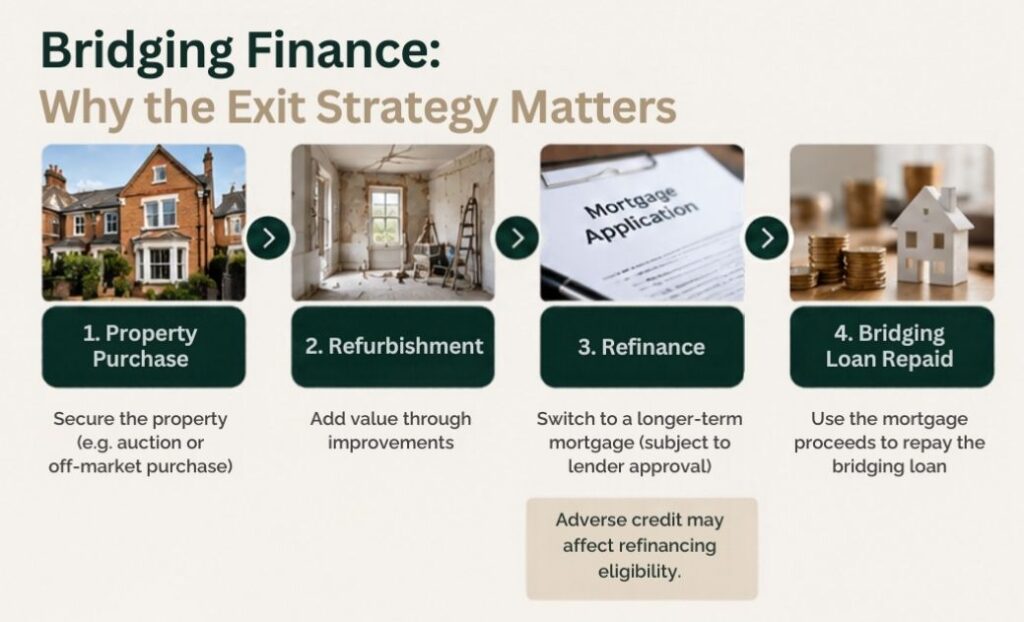
Bridging Finance: Why the Exit Strategy Matters
Bridging loans are commonly used for property purchases, auction transactions, refurbishment projects and short-term refinancing. Because these loans are designed to be repaid within a relatively short period, lenders often place considerable importance on the property being offered as security and the borrower’s proposed exit strategy.
Consider an investor purchasing a property at auction that requires substantial refurbishment before it can be rented out. A bridging loan may provide the short-term funding needed to complete the purchase and renovation, with the intention of refinancing onto a buy-to-let mortgage once the property is ready. If the investor has adverse credit, a specialist lender may still consider the application, but the credit issues could also affect their ability to secure the longer-term mortgage needed to repay the bridging loan.
This highlights an important risk that investors sometimes overlook. Securing the initial bridging finance does not necessarily mean the proposed refinancing will be achievable. Before committing to short-term borrowing, investors should consider whether the exit strategy remains realistic considering their credit history, the property’s expected value and the lending criteria likely to apply when refinancing.
Buy-to-Let Mortgages: Looking Beyond the Borrower’s Credit Score
For buy-to-let investors, lenders generally assess the property’s rental potential alongside the borrower’s deposit, financial commitments and credit history. Rental affordability is particularly important, with many lenders using an Interest Coverage Ratio (ICR) to assess whether the expected rent is sufficient relative to mortgage interest payments under their lending criteria.
At Ichiban Capital, we previously arranged a £1.875 million buy-to-let financing transaction at 75% LTV for a property investment in Buckinghamshire. While this transaction is not presented as an adverse credit case, it illustrates how the relationship between property value and borrowing requirements forms an important part of structuring buy-to-let finance. For investors with adverse credit, these considerations become even more relevant, as lenders may assess the available equity alongside the nature and timing of previous credit issues.
However, strong rental income or a substantial deposit does not automatically compensate for serious credit problems. An investor may have a financially attractive rental property but still face a limited selection of lenders if their credit history falls outside conventional criteria. The challenge is therefore finding a mortgage that works for both the borrower’s circumstances and the property’s expected cash flow.
Commercial Property Finance: Assessing the Wider Transaction
Commercial property finance can support the purchase or refinancing of offices, warehouses, retail units and other commercial premises. Unlike standard residential mortgages, commercial lenders may place greater emphasis on the property’s intended use, business performance and the financial strength of the transaction.
For example, a business owner purchasing a warehouse for their operations may be assessed on the company’s trading performance and ability to service the debt, while an investor acquiring a tenanted retail unit may face greater scrutiny of rental income, tenant quality and lease arrangements. Where adverse credit is involved, specialist commercial lenders may consider these factors alongside the borrower’s financial history, although the overall risk must still meet their lending requirements.
Can a Larger Deposit Improve Your Chances?
The amount of equity available can influence which financing options are realistic, particularly for investors with adverse credit. Lenders use the loan-to-value ratio (LTV) to measure borrowing against the property’s value, and a lower LTV generally provides a larger equity buffer.
For example, on a property valued at £400,000, borrowing £320,000 represents 80% LTV, while borrowing £240,000 represents 60% LTV. The second arrangement exposes the lender to a smaller loan relative to the property’s value, which may make the transaction more attractive from a risk perspective. However, a lower LTV does not automatically offset adverse credit, and some lenders may still restrict applications involving recent defaults, outstanding CCJs or other serious credit issues
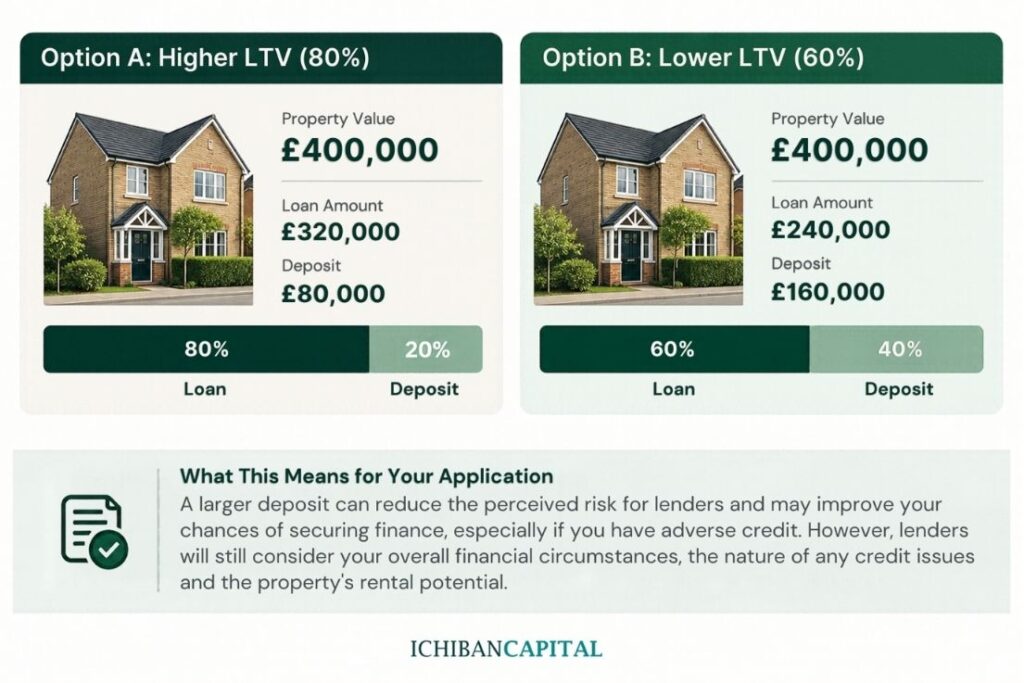
Investors should also consider the wider implications of committing additional capital to a deposit. While a larger deposit may improve borrowing options, it could leave less funding available for refurbishment, unexpected expenses or future investments. The most suitable financing structure should balance lender requirements with the investor’s overall financial position.
Can You Refinance a Property with Bad Credit?
Refinancing may still be possible if an investor’s credit history has deteriorated since taking out the original mortgage, although the available options may be more limited. Lenders will typically reassess the borrower’s current financial circumstances alongside the property’s value, available equity and rental affordability.
Consider a landlord who purchased a buy-to-let property several years ago and now wants to release equity for another investment. Since the original purchase, they have experienced financial difficulties and missed several credit card payments. Even if the property has increased in value and continues to generate rental income, a new lender will still need to assess the landlord’s current credit position. The available equity may support the application, but it does not remove the impact of recent credit issues.
Refinancing decisions should also account for the total cost of borrowing, including arrangement fees, valuation costs, legal expenses and any early repayment charges. This is particularly important for investors planning to refinance out of a bridging loan, as delays or a lower-than-expected refinancing amount could create additional financial pressure.
How Can Investors Strengthen Their Applications?
Although there is no guaranteed way to secure property finance with adverse credit, careful preparation can help investors understand which options are realistic. The first step is to review credit reports, check whether defaults or CCJs have been satisfied and correct any inaccurate information. Being able to explain the circumstances behind previous financial difficulties may also help lenders understand the application.
Investors should then assess the proposed transaction realistically. For buy-to-let properties, this means considering the deposit, expected rental income and ongoing property costs. For refurbishment projects, the budget should account for financing costs, potential delays and a credible repayment strategy. Preparing relevant documents, including bank statements, income information, deposit evidence and details of existing borrowing, can also make the application process more straightforward.
Finally, it is important to look beyond the headline interest rate. Arrangement fees, legal and valuation costs, repayment conditions and potential exit charges can all affect the overall cost of finance. An available loan is not necessarily the most suitable option for a particular investment.
How Can Ichiban Capital Help?
Finding suitable property finance can become more complicated when an investor’s credit history does not meet conventional lending criteria. Different lenders may take different approaches to historic defaults, CCJs and recent missed payments, while the property type, LTV and repayment strategy can further influence eligibility.
At Ichiban Capital, we work with property investors, landlords and developers seeking specialist funding solutions, including bridging loans, buy-to-let mortgages and commercial property finance. By understanding the property, funding requirements and wider financial circumstances, we help clients explore appropriate financing options and make informed borrowing decisions.
If you’re planning a property purchase, refurbishment or refinancing and are unsure how your credit history may affect your options, contact Ichiban Capital to discuss your financing requirements.
All finance remains subject to lender approval, valuation, affordability assessments and applicable lending criteria.
Final Thoughts
Having adverse credit does not necessarily prevent property investors from securing finance in the UK, but it makes understanding the available options more important. Lenders consider a combination of factors, including the nature of previous credit issues, property value, available equity and the proposed repayment strategy.
Rather than focusing solely on whether a loan can be approved, investors should consider whether the financing structure supports their wider investment plans. This is particularly important for short-term borrowing, where a credible exit strategy is essential.
At Ichiban Capital, we help investors explore specialist property finance solutions suited to their circumstances and investment objectives.
Frequently Asked Questions
Can I get a bridging loan with a CCJ?
Some specialist bridging lenders may consider applicants with CCJs, depending on the age, amount and status of the judgment. Property security, LTV and the proposed exit strategy may also influence the decision.
Is there a minimum credit score for UK property finance?
There is no single minimum credit score applied by all UK lenders. Each lender uses its own underwriting criteria and assesses credit history alongside other financial factors.
Can I get a buy-to-let mortgage with bad credit?
Some specialist lenders may consider applicants with adverse credit. Eligibility depends on the nature of the credit issues, available deposit, rental income and the lender’s requirements.
Will a larger deposit help if I have adverse credit?
A larger deposit reduces the LTV and may improve the financing options available. However, it does not guarantee approval, particularly where recent or serious credit issues exist.