

England’s housing shortage is often presented as a simple question of supply: are enough homes being built? Yet the reality is more complicated. Some households struggle to find suitable accommodation, while others live in properties with more bedrooms than they need. The issue is not only how many homes exist, but whether those homes are in the right locations, provide the right amount of space and remain affordable to the households that need them.
According to the English Housing Survey 2024–25, 40% of households in England—around 10 million—were living in under-occupied homes under the Bedroom Standard. At the same time, approximately 3%, or 824,000 households, were living in overcrowded conditions. Because the annual survey sample of overcrowded households is relatively small, the overcrowding estimate is based on a three-year average. Together, these figures reveal a housing mismatch: England has substantial residential space, but it is not always available where demand is greatest.
A Mismatch Across the Housing Market
The contrast becomes clearer when the figures are examined by tenure. In 2024–25, 55% of owner-occupied households were under-occupied, compared with 15% of privately rented households and 10% of socially rented households. Overcrowding showed the opposite pattern, affecting approximately 1% of owner-occupiers, 6% of private renters and 9% of social renters.
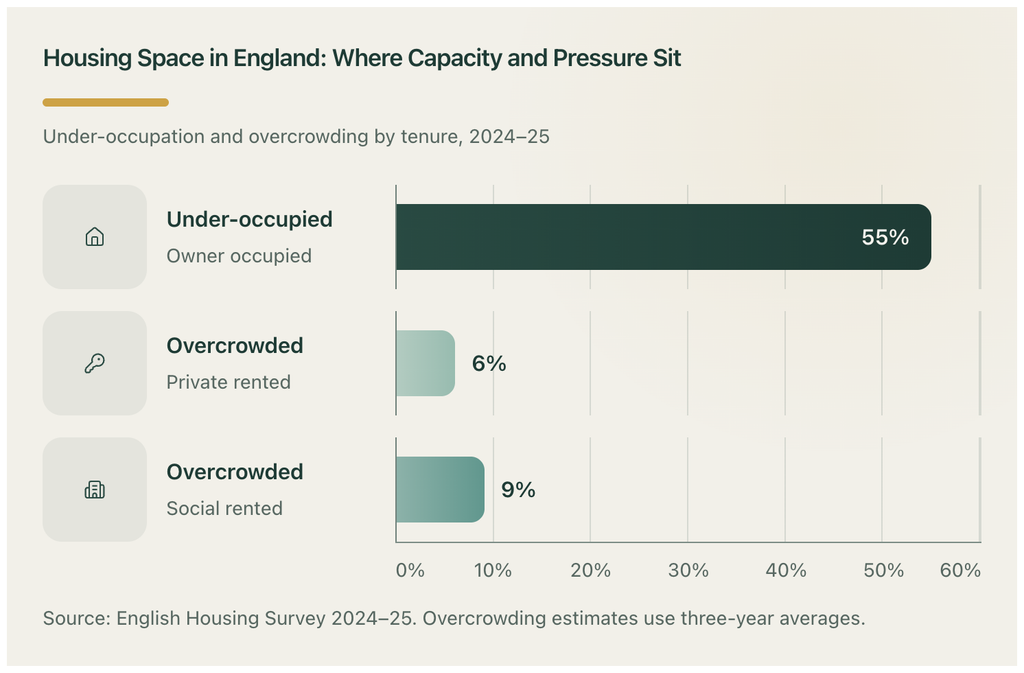
This suggests that much of England’s spare housing capacity is concentrated in the owner-occupied sector, while more immediate pressure is found in the rental sectors. Spare capacity in one part of the market cannot automatically meet demand in another. Ownership, affordability, rents, location and access to suitable properties all influence whether existing housing can respond to changing needs.
A spare bedroom is also not the same as an available home. An older couple may remain in a large family property because they want to stay near familiar services, friends and relatives. Meanwhile, a younger family may be unable to afford a suitable home in the same area. The financial and practical costs of moving can discourage households from relocating, particularly when smaller alternatives are limited or offer poor value. Geography creates another constraint: an under-occupied property in one part of England cannot directly relieve overcrowding elsewhere, especially where employment, transport, schools and property prices differ.
Changing Households, Changing Opportunities
Housing needs change with age, income, employment and household composition. A university city may experience sustained demand from students and younger renters, while an area with an ageing population may need smaller, more accessible homes that allow residents to remain close to their communities. Changes in commuting patterns and remote working may also affect the importance residents place on location, transport and internal space.
In 2024–25, around 65% of households in England were owner-occupiers, 19% were private renters and 16% were social renters. The physical characteristics of these properties also varied. In 2024, owner-occupied homes had an average usable floor area of 110 square metres, compared with 76 square metres in the private rented sector. Around 32% of private rented properties were built before 1919, compared with 20% of owner-occupied homes.
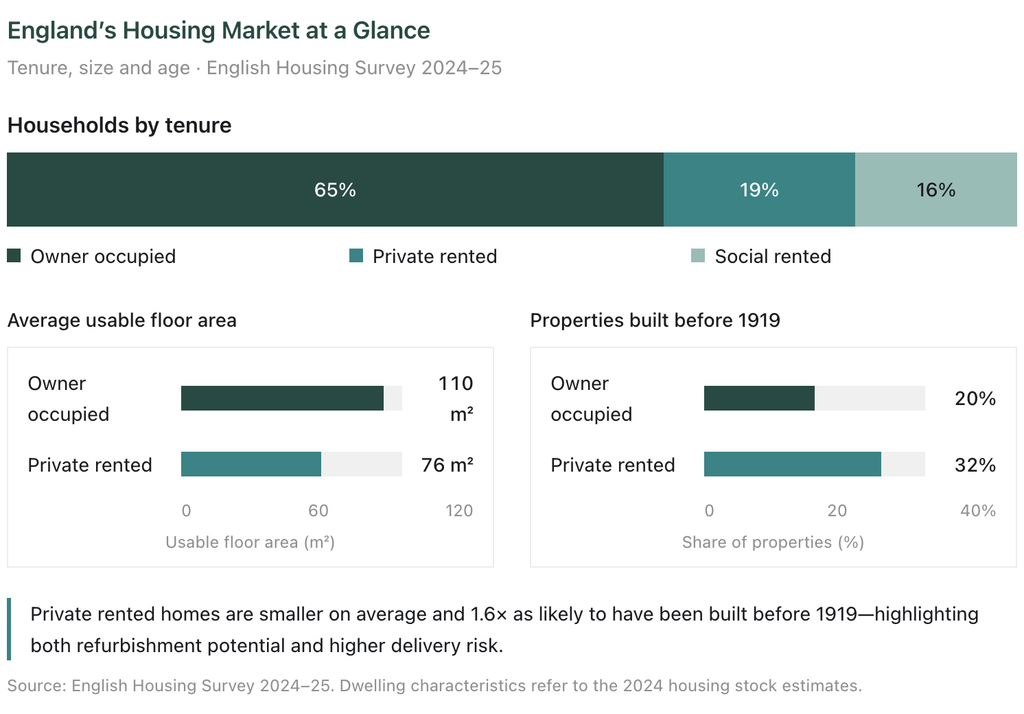
For investors, the larger proportion of older and smaller properties in the private rented sector may create opportunities for refurbishment, energy-efficiency improvements, reconfiguration or conversion. However, older properties can also involve higher maintenance costs and more complicated building work. A low acquisition price may reflect structural repairs, outdated services, insulation requirements or fire safety and compliance work that have not yet been included in the development budget. Projects of this kind may therefore require carefully structured refurbishment finance or development finance that covers both the acquisition and the proposed works.
Turning Housing Demand into an Investment Opportunity
A housing shortage does not automatically create a viable investment. Investors need to understand what type of accommodation is missing, who needs it and what those households can afford. Smaller homes may attract strong demand in employment centres, university locations or well-connected neighbourhoods, while family-oriented areas may place greater value on additional bedrooms, outdoor space and access to schools. Local rents, household incomes, vacancy periods, competing developments and transport connections are generally more useful than national shortage figures when assessing a specific project.
Converting a larger property into smaller residential units may appear to address local demand, but the number of units that can theoretically be created is only part of the calculation. Planning permission, building regulations, fire safety, sound insulation, natural light, access and minimum space requirements may all affect what can actually be delivered. The completed units must also achieve rents or sale prices that justify the acquisition cost, building work, professional fees, property finance costs and development risk.
The strongest opportunities are therefore not necessarily found in areas with the largest headline shortages. They are found where there is evidence of local demand, the property is suitable for the proposed use, development costs are realistic, and the completed accommodation is affordable to its intended market. Housing need may reveal a potential opportunity, but commercial viability depends on whether the project can be delivered profitably and financed appropriately.
From Property Opportunity to the Right Property Finance
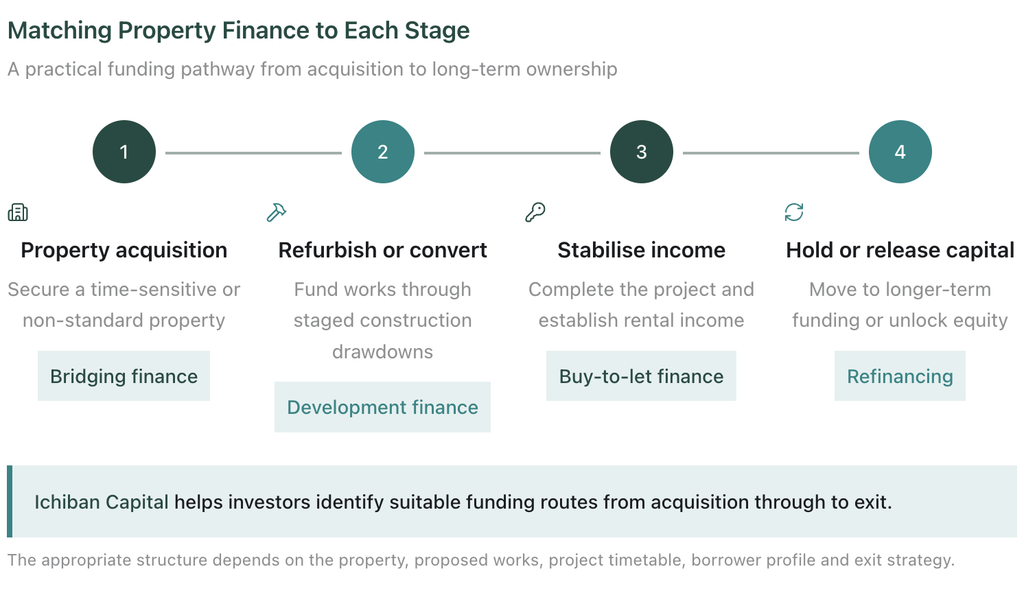
Finding a promising property is only the beginning. Investors must also determine which type of property finance is appropriate and whether the proposed funding structure reflects the property’s condition, project timetable and intended exit.
A property that is not immediately suitable for a conventional mortgage may require short-term bridging finance to support the acquisition. A major refurbishment, conversion or ground-up development may need development finance released in stages as construction progresses. Once the project is complete and producing stable income, the investor may consider buy-to-let finance or longer-term refinancing.
The appropriate funding route will depend on the purchase price, current property value, proposed works, planning status, development budget, expected completed value and projected rental income. Lenders may also consider the borrower’s experience, ownership structure and proposed exit. Reviewing these issues before committing to a purchase can reduce the risk of an unexpected funding gap, unsuitable loan terms or a project timetable that does not match the finance available.
Financing can also have a significant effect on returns. Planning or construction delays may extend the borrowing period and increase interest and holding costs. Higher building costs may reduce the development margin, while a lower completed valuation may limit sale proceeds or the amount available through refinancing. Investors should therefore test the project against less favourable assumptions, including cost overruns, longer delivery times, weaker rents and lower valuations.
The exit strategy should influence the property finance structure from the outset. If the plan is to sell after completion, the project should remain viable at a more conservative sale price. If the property will be retained, projected rental income and completed value should support the expected buy-to-let finance or refinancing. A commercially sound project brings together genuine demand, a suitable property, realistic costs, adequate contingency funding and a clear route to repayment or refinance.
Conclusion: The Opportunity Must Also Be Financeable
England’s housing paradox cannot be understood through national supply totals alone. Spare bedrooms do not eliminate local shortages, and additional construction will not meet demand unless the resulting homes are suitable, well located and affordable. For investors and developers, the important question is not simply where housing is scarce, but where a particular type of accommodation can meet identifiable demand on commercially realistic terms.
Market research may reveal the opportunity, but the project will only become viable when the property, development plan, costs, funding and exit strategy work together. Assessing the finance at an early stage is therefore just as important as assessing the property itself.
Planning a Property Investment or Development Project?
Whether you are acquiring an investment property, carrying out a refurbishment, converting an existing building or planning a new development, the right funding structure can directly affect the project’s viability and eventual return.
Ichiban Capital helps property investors and developers explore a range of property finance options, including bridging finance, development finance, refurbishment finance, buy-to-let finance and refinancing. We assess the property, proposed works, development costs, planning position, project timetable and intended exit before identifying suitable funding routes through our network of specialist lenders.
If you have identified a potential project, send us the property address, purchase price or current valuation, details of the proposed works, estimated development costs, planning status, expected completed value, projected rental income and exit strategy.
Contact Ichiban Capital today to discuss your project and identify a practical property finance solution before you commit to the purchase or begin development.
References
- Ministry of Housing, Communities and Local Government (2026). English Housing Survey 2024 to 2025: Headline Findings on Housing Quality and Energy Efficiency. https://www.gov.uk/government/statistics/chapters-for-english-housing-survey-2024-to-2025-headline-findings-on-housing-quality-and-energy-efficiency
- Ministry of Housing, Communities and Local Government (2025). English Housing Survey 2024 to 2025: Headline Findings on Demographics and Household Resilience. Updated 9 July 2026. https://www.gov.uk/government/statistics/chapters-for-english-housing-survey-2024-to-2025-headline-findings-on-demographics-and-household-resilience